
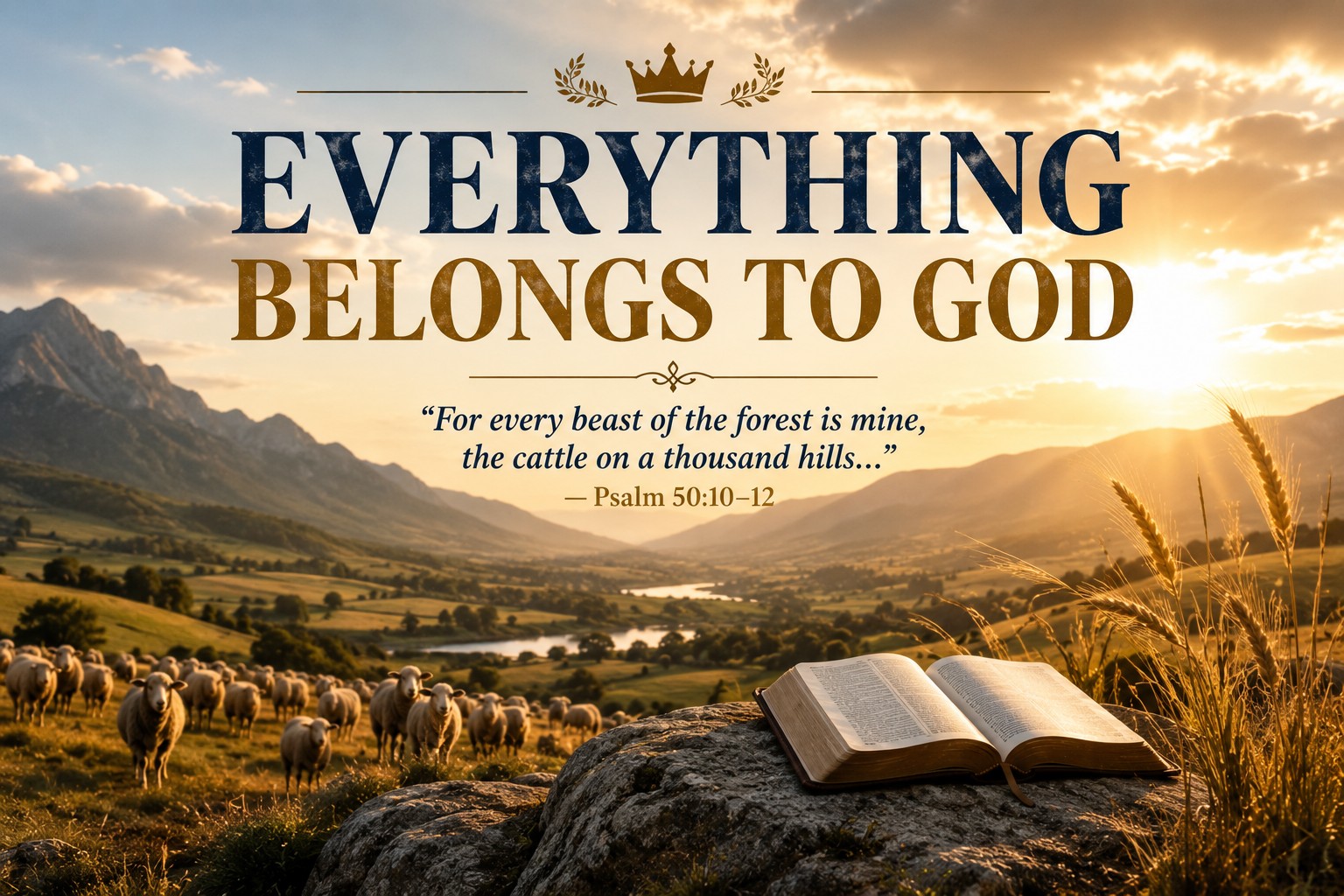
“For every beast of the forest is mine, the cattle on a thousand hills…”
— Psalm 50:10–12
The Illusion of Ownership
There is a story we tell ourselves so consistently and so convincingly that most of us never stop to question it.
The story goes like this: I worked hard. I sacrificed. I made the right calls, took the right risks, showed up when it was hard, and built something out of nothing. This is mine. I earned it.
And look—that story is not entirely wrong. You did work hard. The sacrifice was real. Nobody handed you anything and you have got the calluses and the sleepless nights to prove it. None of that is up for debate.
But there is a piece of that story that is quietly, completely wrong. And if you let it go unchecked long enough, it will shape every decision you make, every resource you hold, and every relationship you are responsible for—in ways you will not even recognize until the weight of it finally catches up with you.
The piece that is wrong is this: the word mine.
Because God spoke first. Before your first day on the job, before your first deal closed, before you ever had the idea that became the thing you built—God looked at all of it and said, mine. Every beast of the forest. The cattle on a thousand hills. The world and everything that fills it.
Not most of it. Not the part you have not gotten to yet. All of it.
Which means the real story—the one underneath the one you have been telling yourself—is not that you built something. It is that God entrusted something to you. And those two things feel similar from the outside, but they are completely different on the inside. And the difference shows up every single time the pressure gets real.
What You Do With What Is Not Yours
Think about what it actually means to manage something that belongs to someone else.
If a friend handed you the keys to their truck and asked you to use it for the week, you would drive it differently than you drive your own. Not because you are a bad person—because you know it is not yours. You would fill the tank before you returned it. You would not park it somewhere sketchy. You would treat it with a little more care than you might treat your own because the weight of accountability sits differently when you know you are going to have to hand it back.
That is stewardship. And that is exactly the posture God is describing in Psalm 50.
He is not making a request. He is not asking you to loosen your grip or be more generous or try a little harder to surrender control. He is making a declaration about reality. This was always mine. You were always the steward. The only question is whether you have been living like it.
And most of us, if we sit with that question long enough to be honest about it, have to admit the answer is not always yes.
We hold resources tightly because losing them feels like losing part of ourselves. We make decisions about our businesses, our money, our time, and our influence based primarily on what protects what we have built—because somewhere underneath all the right language about faith and surrender, we still feel like owners. And owners protect their assets.
But here is what changes when you actually internalize that none of it is yours.
Generosity stops being a sacrifice and starts being stewardship. Because you are not giving away something you worked for—you are being faithful with something He entrusted to you. The decision is completely different when you reframe who actually owns what you are holding.
Pressure stops being existential. Because an owner whose business struggles feels like their identity is on the line. A steward whose assignment gets hard feels accountable—and that is real—but they do not feel like the floor is disappearing beneath them. The outcome belongs to the Owner. The faithfulness belongs to you.
And generosity, risk, obedience—all of it gets easier when you stop doing the math on your own money and start doing the math on His.
Hold It Loosely and Lead It Well
I want to be careful here because this truth gets misapplied in a way that costs people something real.
Stewardship is not passivity. It is not a spiritual excuse to stop caring about results or stop working hard or float through your responsibilities with a detached, “well, it all belongs to God anyway” shrug. That is not faithfulness. That is laziness wearing a theology costume.
A steward works harder than an owner in some ways—because a steward is accountable. You will answer for what you did with what He gave you. The talent buried in the ground did not get a pass because it was kept safe. It got called out because it was not used.
So the call is not to care less. It is to care differently.
Work hard—because the One who gave you this expects faithfulness with it. Lead well—because the people in your care are also His, and how you treat them matters. Be generous—not because you can afford to be, but because it was never yours to hoard in the first place. Make the courageous call—because a steward who knows the Owner is good does not have to make every decision from a place of fear.
The cattle on a thousand hills belong to God. So does the business you are building, the influence you are carrying, the family you are leading, and the resources in your hands right now.
You did not create any of it from nothing. You were handed a stewardship and asked to be faithful with it.
The most important question you can ask yourself today is not how much of it you are willing to give. It is whether the way you are living looks like someone who actually believes who the real Owner is.
Because the way you hold things—tightly or loosely, fearfully or faithfully—tells the truth about what you actually believe, regardless of what you say on Sunday.
Hold it loosely. Lead it well. Answer for it honestly.
That is the whole job.
Prayer
Heavenly Father,
Thank You for the gifts and strengths You have placed in me. Sometimes, I struggle to see them or believe they matter. Help me to recognize that You have given me these abilities for a reason—not to hide them, but to use them for Your glory.
Lord, give me the courage to step forward in faith, even when I feel unqualified. Help me to trust that You equip those You call. I surrender my doubts, my fears, and my insecurities to You. Strengthen me to cultivate my potential and to use what You have given me to bless others.
I ask for wisdom in discovering how I can best serve. Open my eyes to opportunities and give me a willing heart to act. Let me be a faithful steward of the gifts You have entrusted to me. May everything, I do bring honor to You and encourage those around me.
Thank You for choosing me, equipping me, and walking with me every step of the way. I trust that as I step forward, You will guide me. I offer my strengths to You, Lord—use them as You will.
In Jesus’ name, Amen.
God bless, and let’s keep Him first in everything we do.
For more uplifting devotionals and prayers, visit God First Life.
Dan Greer